
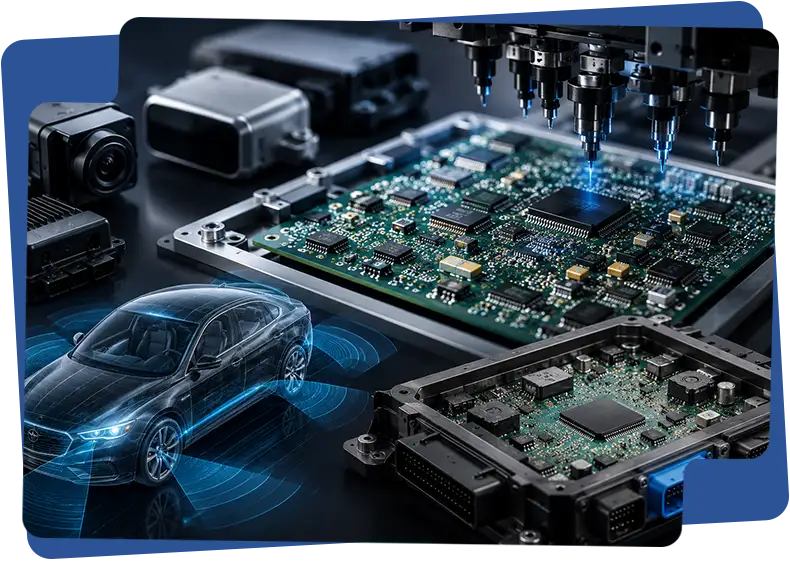
How ADAS Electronics are Manufactured: Powering the Future of Safer Mobility
Modern vehicles are becoming smarter, safer and more connected than ever before. At the heart of this transformation lies Advanced Driver Assistance Systems (ADAS) – a suite of technologies designed to enhance driver safety, improve vehicle performance and pave the way for autonomous driving.
From automatic emergency braking and lane departure warnings to adaptive cruise control and 360° camera systems, every ADAS feature relies on highly reliable electronic assemblies. Manufacturing these electronics requires precision, stringent quality standards and advanced manufacturing capabilities.
What are ADAS Electronics?
ADAS systems combine multiple electronic components that continuously monitor the vehicle’s surroundings and process real-time data. These include:
- High-performance Printed Circuit Board Assemblies (PCBAs)
- Camera control modules
- Radar and LiDAR electronic assemblies
- Sensor interface boards
- Electronic Control Units (ECUs)
- Power management modules
- Communication modules
These assemblies work together to ensure rapid and accurate decision-making while the vehicle is in motion.
The Manufacturing Process of ADAS Electronics
1. Design for Manufacturability (DFM)
The journey begins with evaluating the product design for manufacturability. Engineers optimize PCB layouts, component placement, thermal management and assembly processes to improve production efficiency and long-term reliability.
2. Precision PCB Assembly
ADAS electronics contain high-density PCBs with fine-pitch components, Ball Grid Arrays (BGAs), QFNs and miniature passive devices. Automated Surface Mount Technology (SMT) lines ensure precise component placement while maintaining high throughput and repeatability.
3. Through-Hole & Hybrid Assembly
Certain automotive connectors, power components and mechanical parts require Through-Hole Technology (THT) or hybrid assembly processes. These provide additional mechanical strength for components subjected to vibration and harsh operating conditions.
4. Automated Optical Inspection (AOI)
Every PCB undergoes Automated Optical Inspection to detect:
- Missing components
- Incorrect polarity
- Solder defects
- Misalignment
- Surface defects
This helps identify manufacturing issues early, ensuring consistent quality.
5. X-Ray Inspection
Hidden solder joints beneath BGAs and other complex packages cannot be inspected visually. Advanced X-ray systems verify solder integrity, voiding and alignment to maintain automotive-grade reliability.
6. Functional Testing
Each assembled board is tested to verify that it performs exactly as intended. Functional testing validates communication interfaces, sensor connectivity, power management and signal integrity before the product proceeds to final assembly.
7. Electromechanical & Box Build Assembly
PCB assemblies are integrated into complete electronic modules by combining:
- Wiring harnesses
- Connectors
- Mechanical enclosures
- Thermal management components
- Power modules
The result is a fully assembled, production-ready ADAS electronic unit.
8. Environmental & Reliability Testing
Automotive electronics must operate reliably under demanding conditions. ADAS modules undergo rigorous testing for:
- Temperature cycling
- Vibration
- Mechanical shock
- Humidity
- Electrical performance
These tests ensure dependable operation throughout the vehicle’s lifecycle.
Why Manufacturing Quality Matters?
ADAS systems directly influence vehicle safety. Even the smallest manufacturing defect can impact system performance. This is why automotive electronics manufacturers follow strict process controls, traceability and internationally recognized quality standards to deliver consistent, high-reliability products.
How inYantra Technologies Supports Automotive Electronics Manufacturing
As a Volex company, inYantra Technologies specializes in manufacturing high-reliability electronic assemblies for demanding industries, including automotive.
Our integrated manufacturing capabilities include:
- PCB Assembly (SMT & THT)
- Electromechanical Assembly
- Box Build Assembly
- Cable & Wiring Harness Assembly
- Functional Testing
- NPI (New Product Introduction)
- End-to-End Manufacturing Support
With a strong focus on quality, precision and process excellence, we help OEMs and Tier-1 suppliers accelerate product development while ensuring reliable manufacturing for next-generation automotive electronics.
The Road Ahead
As vehicles continue to evolve with electrification, connectivity and autonomous technologies, the demand for sophisticated ADAS electronics will continue to grow. Manufacturers that combine advanced PCB assembly, rigorous quality control and integrated electromechanical manufacturing will play a vital role in enabling safer, smarter mobility.
Whether developing radar modules, sensor control units or intelligent electronic systems, choosing the right manufacturing partner is essential for delivering the reliability today’s automotive industry demands.
Looking for a trusted manufacturing partner for automotive electronics?
inYantra Technologies provides precision PCB Assembly and Electromechanical Assembly solutions that support the next generation of ADAS, EV and connected vehicle technologies with quality, reliability and manufacturing excellence.