
Drone Manufacturing in India: Building the Electronics Backbone of Next-Generation UAVs
India’s drone industry is rapidly evolving from a niche technology segment into a strategic manufacturing sector. With applications expanding across defense, agriculture, surveying, infrastructure inspection, mining, disaster management and logistics, drones are becoming an essential tool for both commercial and government operations.
Supported by initiatives such as the Drone Rules, Production-Linked Incentive (PLI) schemes and the broader Make in India vision, the country is witnessing growing investment in indigenous drone design and manufacturing capabilities.
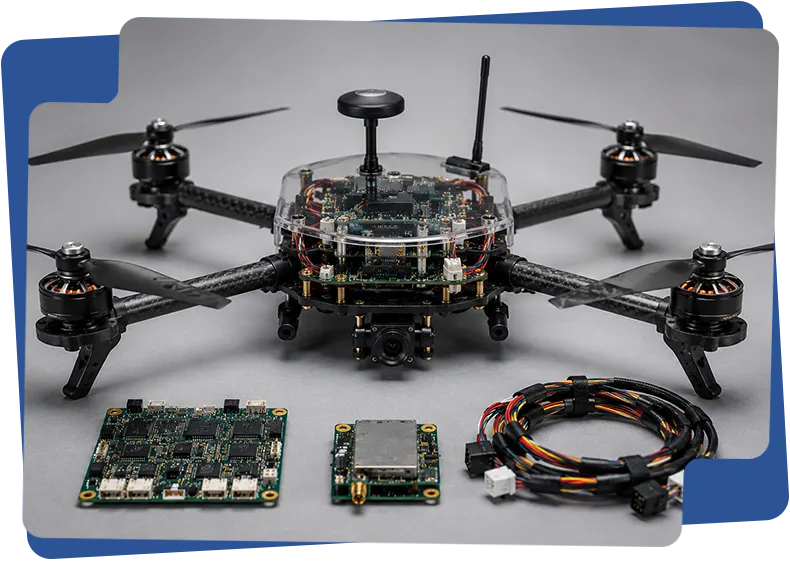
While much attention is given to drone airframes, propulsion systems and flight performance, the true intelligence of a drone lies within its electronics ecosystem.
The Electronics That Power Modern Drones
A drone is a highly integrated electronic system that relies on multiple interconnected subsystems working together in real time. These include:
Flight Controller Systems
The flight controller serves as the drone’s central processing unit, managing navigation, stabilization and flight operations. It continuously processes data from various sensors and adjusts motor outputs to maintain controlled flight.
Communication Modules
Reliable communication is critical for command, control, telemetry and data transmission. Depending on the application, drones may utilize RF modules, LTE/5G communication systems, satellite links or specialized long-range communication technologies.
Power Distribution and Battery Management
Power distribution boards, battery management systems (BMS), voltage regulators and power monitoring circuits ensure efficient energy utilization while maintaining safety and reliability during flight.
Sensor Integration
Modern drones incorporate multiple sensors such as:
- GPS and GNSS modules
- Inertial Measurement Units (IMUs)
- Accelerometers and gyroscopes
- Cameras and imaging systems
- LiDAR sensors
- Environmental and obstacle-detection sensors
These sensors generate the data required for autonomous navigation and mission execution.
Wiring Harness Assemblies
Drone wiring harnesses connect critical electronic subsystems throughout the platform. They must be lightweight, durable, vibration-resistant and capable of operating reliably under varying environmental conditions.
Embedded Control Electronics
Additional PCBs manage payload systems, camera stabilization, communication interfaces, mission control functions and specialized application requirements.
Manufacturing Challenges in Drone Electronics
As drone applications become more sophisticated, manufacturers face several production challenges.
Miniaturization Requirements
Drone electronics must be compact and lightweight without compromising functionality. High-density PCB designs and precision assembly processes are essential for achieving optimal performance.
Reliability Under Harsh Conditions
Drones often operate in demanding environments involving:
- High vibration
- Temperature fluctuations
- Dust and moisture exposure
- Extended operational cycles
Electronic assemblies must be designed and manufactured to withstand these conditions.
Scalability from Prototype to Production
Many drone companies begin with prototype builds but face difficulties when transitioning to volume manufacturing. Consistent quality, supply chain management and repeatable assembly processes become increasingly important as production scales.
Complex System Integration
A drone combines electronics, mechanical structures, firmware, communication systems and power systems into a single platform. Effective manufacturing requires seamless integration across these disciplines.
The Growing Need for Electronics Manufacturing Partners
As India’s drone ecosystem expands, manufacturers increasingly seek partners capable of supporting multiple stages of production under one roof.
An integrated electronics manufacturing approach offers several advantages:
- Faster product development cycles
- Reduced supply chain complexity
- Improved quality control
- Better traceability
- Easier scalability from pilot builds to mass production
This becomes particularly valuable for drone OEMs focused on innovation while outsourcing manufacturing execution to specialized EMS providers.
How Electronics Manufacturing Supports Drone Production
PCB Assembly
High-quality PCB assembly forms the foundation of drone electronics. Precision SMT assembly enables the production of flight controllers, communication modules, power management systems and sensor interface boards.
Cable and Wiring Harness Assembly
Reliable harness assemblies ensure secure connections between motors, batteries, sensors, payload systems and control electronics. Proper harness design and assembly contribute directly to system reliability and operational safety.
Box Build Integration
Box build assembly brings together electronic assemblies, mechanical components, enclosures, connectors and sub-systems into a complete production-ready unit. This integration helps reduce complexity for drone manufacturers while improving consistency across builds.
Testing and Validation
Comprehensive testing is critical to ensuring product reliability. Functional testing, continuity verification, inspection processes and quality control measures help identify issues before deployment.
Emerging Trends Shaping Drone Manufacturing
The next phase of drone innovation will be driven by advancements in:
AI-Enabled Autonomous Operations
Artificial intelligence is enabling drones to perform complex missions with minimal human intervention, creating demand for more powerful embedded computing systems.
Beyond Visual Line of Sight (BVLOS) Operations
As regulations evolve, drones will require enhanced communication systems and more sophisticated onboard electronics to support long-range operations.
Advanced Payload Integration
Applications such as precision agriculture, mapping, inspection and surveillance continue to drive demand for specialized sensors and payload systems.
Indigenous Component Ecosystems
The push for localization is encouraging the development of domestic supply chains for electronics, subsystems and manufacturing services, reducing dependence on imports.
The Future of Drone Manufacturing in India
India is well positioned to become a global hub for drone innovation and production. The combination of engineering talent, supportive government policies, growing domestic demand and expanding manufacturing infrastructure creates significant opportunities across the value chain.
As drones become increasingly sophisticated, the quality and reliability of their electronic systems will play a defining role in performance, safety and scalability.
From flight control systems and communication modules to wiring harnesses and complete system integration, electronics manufacturing will remain at the heart of every successful drone platform.
For drone OEMs looking to scale from concept to commercial production, partnering with an experienced electronics manufacturing provider can help accelerate development, improve quality and bring products to market faster.
About inYantra
inYantra supports drone manufacturers with end-to-end electronics manufacturing services including PCB Assembly, Cable & Wiring Harness Assembly, Box Build Integration and Testing. By combining advanced manufacturing capabilities with scalable production support, inYantra helps transform innovative drone concepts into production-ready systems.