
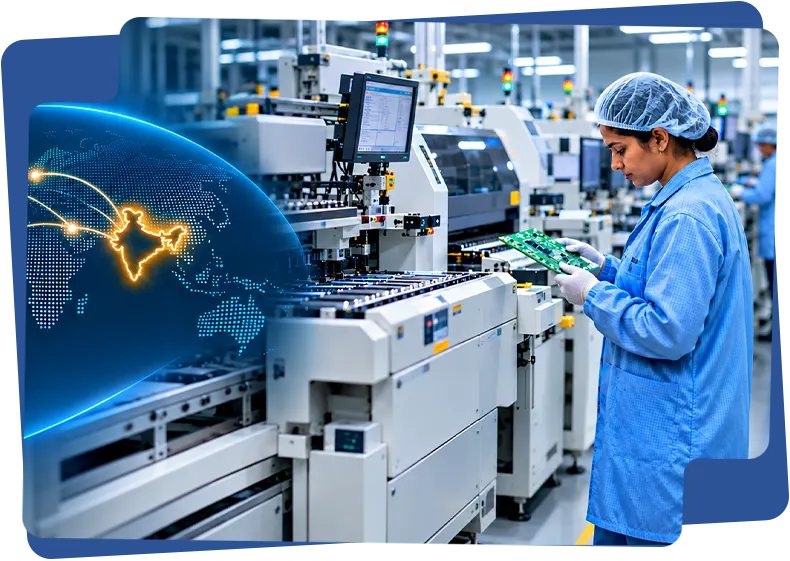
Introduction: India’s Growing Role in Global Electronics Manufacturing
The global electronics manufacturing landscape is undergoing a significant transformation. Businesses are increasingly evaluating where and how their products are manufactured, assembled and delivered to international markets.
Supply chain diversification, rising demand for electronic products, geopolitical uncertainties and the need for manufacturing flexibility have encouraged global companies to explore new manufacturing destinations.
India is emerging as an important part of this transition.
Over the past decade, the country’s electronics manufacturing industry has expanded significantly. According to the Government of India’s Ministry of Electronics and Information Technology, electronics production increased from approximately ₹1.9 lakh crore in FY 2014–15 to ₹13.11 lakh crore in FY 2025-26. Electronics exports also grew from approximately ₹38,000 crore to ₹4.24 lakh crore during the same period.
PIB+1
This growth reflects India’s expanding manufacturing capabilities, stronger industrial infrastructure and increasing integration with global supply chains.
But what exactly makes India an attractive destination for global electronics manufacturers?
Let’s explore the key factors.
1. Supply Chain Diversification and Manufacturing Resilience
Recent global disruptions have highlighted the importance of building resilient and diversified supply chains.
Companies that depend heavily on a single manufacturing geography may face challenges related to logistics disruptions, trade restrictions, geopolitical uncertainties and component availability.
As a result, global OEMs are exploring additional manufacturing locations to reduce supply chain concentration and improve operational flexibility.
India offers an opportunity to diversify manufacturing operations while maintaining access to a large industrial ecosystem.
For international companies, working with Indian Electronics Manufacturing Services (EMS) providers can create additional manufacturing options, support regional sourcing strategies and strengthen supply chain continuity.
The objective is not necessarily to replace existing manufacturing locations, but to build a more balanced and resilient global manufacturing network.
2. Government Initiatives Supporting Electronics Manufacturing
Government policies have played an important role in developing India’s electronics manufacturing ecosystem.
Initiatives such as:
- Make in India
- Production Linked Incentive (PLI) Scheme
- Electronics Components Manufacturing Scheme (ECMS)
- Modified Electronics Manufacturing Clusters (EMC 2.0)
- India Semiconductor Mission
are designed to encourage investment, strengthen domestic manufacturing capabilities and support the development of electronics components and semiconductor-related industries.
For example, the Electronics Components Manufacturing Scheme was introduced to strengthen domestic component production and integrate Indian manufacturers more deeply into global value chains. Its budgetary outlay was increased to ₹40,000 crore in the Union Budget 2026–27.
PIB+2
These initiatives are helping create an environment where domestic and international manufacturers can explore long-term manufacturing opportunities.
3. Expanding Electronics Manufacturing Infrastructure
One of the most important factors influencing manufacturing decisions is the availability of reliable infrastructure.
India’s electronics manufacturing ecosystem has expanded beyond basic product assembly. Manufacturers are increasingly developing capabilities across:
- Surface Mount Technology (SMT) and PCB Assembly.
- Through-Hole Technology (THT) assembly.
- Cable and wiring harness manufacturing.
- Electromechanical assembly.
- Box Build and system integration.
- Testing, inspection and quality assurance.
This broader capability base allows OEMs to work with manufacturing partners who can support different stages of the product manufacturing process.
For companies looking to establish or expand manufacturing operations, access to these capabilities can simplify supplier coordination and improve production planning.
4. Skilled Workforce and Engineering Capabilities
Electronics manufacturing requires a combination of technical expertise, process knowledge and operational discipline.
India has a large engineering and technical workforce supporting industries such as automotive, telecommunications, industrial electronics, consumer electronics and medical devices.
The availability of engineers, technicians, production specialists and quality professionals creates opportunities for companies seeking manufacturing partners with technical and operational capabilities.
As manufacturing processes become increasingly automated and sophisticated, workforce development and technical training will remain important to India’s competitiveness.
5. Cost Competitiveness and Operational Efficiency
Manufacturing cost remains an important consideration when companies evaluate new production locations.
India offers opportunities for cost competitiveness through its workforce, growing supplier ecosystem, manufacturing clusters and expanding industrial infrastructure.
However, cost advantages should not be measured through labour costs alone.
OEMs must also evaluate:
- Manufacturing quality and process consistency.
- Component sourcing and availability.
- Production scalability.
- Logistics and transportation.
- Supplier reliability.
- Testing and compliance requirements.
A manufacturing partner that combines cost competitiveness with quality, process control and delivery reliability can create greater long-term value than one selected purely on the basis of production cost.
6. Growing Opportunities Across Industry Sectors
Electronics manufacturing opportunities in India are expanding across several industrial sectors.
Automotive and Electric Vehicles
The growing adoption of electronic control systems, vehicle connectivity, sensors and EV infrastructure is increasing demand for specialised electronic assemblies.
Telecommunications and Broadband
The expansion of digital connectivity is driving demand for networking equipment, optical communication systems, GPON, ONT and other broadband-related electronics.
Medical Electronics
Medical equipment manufacturers require reliable electronic assemblies supported by controlled manufacturing processes and stringent quality standards.
Industrial Electronics
Industrial automation, power management, monitoring systems and control equipment are creating demand for sophisticated electronic manufacturing capabilities.
Defence and Aerospace
Increasing electronic integration in communication, surveillance, navigation and mission-critical systems is creating opportunities for specialised manufacturing and assembly.
These sectors demonstrate how electronics manufacturing is becoming an increasingly important part of India’s industrial development.
7. Opportunities Through Strategic EMS Partnerships
Establishing manufacturing operations in a new country involves several considerations, including infrastructure investment, supplier development, workforce planning, quality systems and production management.
This is where an established Electronics Manufacturing Services (EMS) partner can add value.
Instead of independently managing multiple manufacturing suppliers, OEMs can collaborate with an EMS provider that offers integrated manufacturing capabilities.
Depending on the partner’s capabilities, these services can include:
- PCB Assembly (PCBA).
- Cable and Wiring Harness Assembly.
- Box Build Assembly.
- Electromechanical Integration.
- Testing and Inspection.
- New Product Introduction (NPI).
- Manufacturing and export support.
An integrated EMS partnership can help companies streamline manufacturing operations, improve coordination between processes and create a more scalable production model.
For global OEMs exploring India, selecting the right manufacturing partner is therefore an important part of the localization strategy.
8. India’s Increasing Integration with Global Markets
India’s electronics manufacturing industry is becoming increasingly connected to international markets.
The growth in electronics exports demonstrates the country’s expanding role in global manufacturing and trade.
According to government data, electronics exports reached approximately ₹4.24 lakh crore in FY 2025–26, representing an eleven-fold increase compared with FY 2014–15.
PIB+1
This expansion creates opportunities for manufacturers to serve both domestic and international customers.
For global OEMs, India can offer a manufacturing base that supports domestic market requirements while also contributing to international supply chains.
As export capabilities, manufacturing infrastructure and component ecosystems continue to develop, India’s position in global electronics manufacturing is expected to become increasingly significant.
Conclusion: India Is Becoming an Important Part of the Global Manufacturing Strategy
India’s emergence as an electronics manufacturing destination is supported by several factors: expanding infrastructure, government initiatives, skilled technical talent, growing supplier ecosystems and increasing export capabilities.
While challenges around component localization, logistics, technology development and supply chain maturity remain, the overall direction indicates significant opportunities for international manufacturers.
For global OEMs, exploring India is no longer simply about finding an alternative production location. It is about building manufacturing partnerships, diversifying supply chains and accessing a rapidly developing industrial ecosystem.
As the industry evolves, the success of this transition will depend on choosing manufacturing partners that understand quality, operational efficiency, scalability and the requirements of global markets.
How inYantra Technologies Supports the Evolving Electronics Manufacturing Ecosystem
At inYantra Technologies (A Volex Company), we contribute to India’s growing electronics manufacturing ecosystem through integrated manufacturing capabilities designed to support OEM requirements across multiple industries.
Our capabilities include:
- PCB Assembly (PCBA)
- Box Build and System Integration
- Cable and Wiring Harness Assembly
- BIS-approved Power Cords
- New Product Introduction (NPI)
- Testing and Manufacturing Support
With manufacturing capabilities serving automotive, medical, industrial, telecommunications and consumer electronics sectors, inYantra supports customers across different stages of electronics manufacturing.
As global companies continue exploring India, we remain focused on delivering manufacturing solutions built around quality, process consistency and operational excellence.
Looking for an electronics manufacturing partner in India?
Explore our capabilities at www.inyantra.com or connect with our team to discuss your manufacturing requirements.