
The Hidden Technology Behind Modern Hospitals: How Electronics Power Modern Healthcare
Modern hospitals are built on a foundation of innovation. While doctors, nurses and healthcare professionals are at the heart of patient care, advanced medical technology plays an equally important role in enabling accurate diagnosis, continuous monitoring and effective treatment.
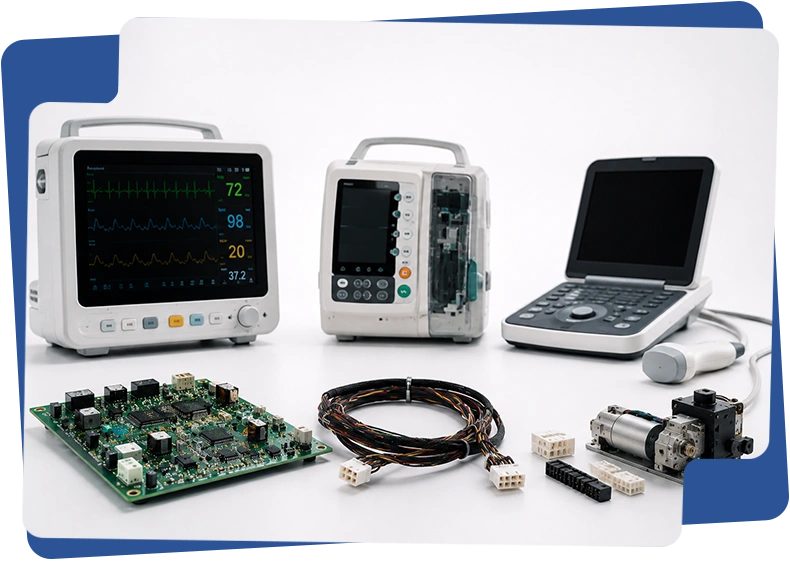
From patient monitors and infusion pumps to diagnostic equipment, modern medical devices rely on sophisticated electronics and precision engineering to deliver reliable performance when it matters most.
Behind every medical device is a complex network of electronic and electromechanical assemblies working together seamlessly.
The Growing Demand for Medical Technology
Healthcare systems worldwide are evolving rapidly. Ageing populations, increasing healthcare needs and advancements in digital technology are driving demand for smarter and more connected medical devices.
Modern healthcare equipment is expected to:
- Deliver accurate and real-time data.
- Operate continuously with high reliability.
- Support remote monitoring and connectivity.
- Improve patient outcomes.
- Enhance clinical decision-making.
Meeting these expectations requires sophisticated electronic systems and high-quality manufacturing.
Patient Monitors: Real-Time Health Monitoring
Patient monitors are among the most essential devices found in hospitals and intensive care units.
These systems continuously measure and display vital parameters such as:
- Heart rate
- Blood pressure
- Oxygen saturation
- Respiratory rate
- Temperature
To perform these functions, patient monitors integrate multiple electronic systems including:
Sensors
Capture physiological data from the patient.
PCB Assemblies
Process signals and manage device operations.
Display Electronics
Present critical information to healthcare professionals.
Communication Modules
Enable data transfer to hospital information systems.
Power Management Systems
Ensure stable and uninterrupted operation.
Reliable electronic assemblies are essential to maintaining accuracy and patient safety.
Infusion Pumps: Precision Medication Delivery
Infusion pumps are designed to deliver fluids, nutrients and medications at carefully controlled rates.
These devices combine electronics with mechanical systems to achieve high levels of precision.
A typical infusion pump incorporates:
- Control PCB assemblies
- Motor drive electronics
- Sensors
- User interface modules
- Cable assemblies
- Power management circuits
These systems work together to ensure accurate and reliable medication delivery.
Diagnostic Equipment: Supporting Clinical Decisions
Modern healthcare relies heavily on diagnostic technologies that provide timely and accurate information.
Examples include:
- Ultrasound systems
- Laboratory analysers
- Portable diagnostic devices
- Patient testing equipment
These products integrate advanced electronics to collect, process and display complex medical data.
Electronic assemblies help enable:
- Signal processing
- Data acquisition
- Image generation
- System control
- Communication and connectivity
As diagnostic equipment becomes increasingly sophisticated, manufacturing quality becomes even more critical.
The Building Blocks of Modern Medical Devices
Although medical equipment varies widely in application, many products share common electronic components.
PCB Assemblies
PCB assemblies form the core of electronic medical systems by connecting and controlling various functions.
Applications include:
- Signal processing
- Device control
- Communication
- User interfaces
- Power distribution
Sensors
Sensors allow medical devices to interact with their environment by measuring physical conditions.
Examples include:
- Temperature
- Pressure
- Flow
- Motion
- Oxygen levels
- Biological signals
These measurements help healthcare professionals make informed decisions.
Power Electronics
Medical devices require stable and efficient power management to ensure reliable operation.
Power electronics help:
- Convert voltage levels.
- Protect sensitive circuits.
- Improve efficiency.
- Support battery-powered applications.
Cable and Wiring Assemblies
Reliable connectivity is essential for complex medical equipment.
Cable and wiring assemblies connect:
- Sensors
- Displays
- Power systems
- Communication modules
- User interfaces
Well-designed assemblies improve product reliability and simplify maintenance.
Electromechanical Assemblies
Many medical devices combine electronics with mechanical components such as:
- Switches
- Connectors
- Motors
- Actuators
- Cooling systems
- Mechanical enclosures
These integrated systems enable complete product functionality.
Manufacturing Challenges in Medical Electronics
Medical technology demands exceptional consistency and quality throughout the manufacturing process.
Key considerations include:
Precision
Complex electronic assemblies require accurate component placement and controlled assembly processes.
Reliability
Medical equipment often operates continuously in demanding environments.
Traceability
Manufacturing processes require comprehensive documentation and process control.
Quality Assurance
Inspection and testing help verify product performance and consistency.
Scalability
Manufacturers must support both low-volume specialised products and higher-volume production requirements.
How inYantra Supports Medical Device Companies
As medical technology continues to advance, OEMs require manufacturing partners capable of supporting increasingly sophisticated electronic and electromechanical assemblies.
At inYantra Technologies, we help medical device companies manufacture critical electronic and electromechanical assemblies used in healthcare products.
Our capabilities include:
✔ PCB Assemblies
✔ Cable and Wiring Assemblies
✔ Electromechanical Assemblies
✔ Box Build Assemblies
✔ System Integration
By working closely with OEMs, we help transform innovative engineering designs into production-ready assemblies that support the next generation of healthcare technology.
The Future of Medical Electronics
Medical technology is becoming increasingly connected, intelligent and portable.
Emerging trends include:
- Remote patient monitoring
- Connected healthcare devices
- Portable diagnostics
- Smart infusion systems
- AI-assisted medical equipment
- Wearable healthcare technology
These innovations will continue to increase the demand for reliable electronic and electromechanical manufacturing.
Conclusion
The modern hospital is powered by far more than medical expertise alone. Patient monitors, infusion pumps and diagnostic equipment all depend on sophisticated electronic systems working together with precision and reliability.
Behind these life-supporting technologies are PCB assemblies, sensors, power electronics, cable assemblies and electromechanical systems that enable critical healthcare applications.
At inYantra Technologies, we help medical device companies manufacture the electronic and electromechanical assemblies that support innovative healthcare products, helping transform advanced designs into reliable manufacturing solutions.
Behind every modern medical device is precision engineering. Behind precision engineering is reliable manufacturing.