
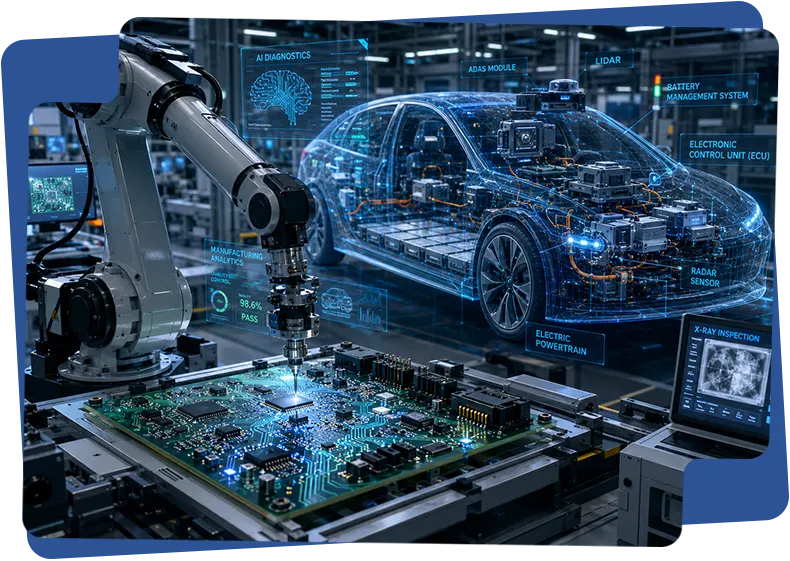
Automotive PCB Assembly: Building the Electronic Backbone of Modern Vehicles
The automotive industry is experiencing one of the biggest technological shifts in its history. Vehicles are no longer purely mechanical machines; they have evolved into intelligent systems powered by sophisticated electronics. From electric powertrains and Advanced Driver Assistance Systems (ADAS) to connected infotainment and battery management systems, electronics have become the driving force behind modern mobility.
At the center of these innovations are Printed Circuit Boards (PCBs), which enable communication, control and safety across numerous vehicle functions. As automotive electronics become more advanced, Electronic Manufacturing Services (EMS) providers are adapting their PCB assembly capabilities to meet the industry’s demanding quality and reliability standards.
Why PCB Assembly Matters in Automotive Electronics
A modern vehicle contains dozens of electronic modules, while electric and hybrid vehicles may incorporate more than 100 Electronic Control Units (ECUs). Each ECU depends on highly reliable assembled PCBs to perform critical tasks such as power distribution, motor control, braking, navigation and sensor management.
Industry studies suggest that the global automotive electronics and software market will continue to expand significantly over the coming years, driven by electrification, autonomous driving technologies and vehicle connectivity.
PCB assembly involves mounting and soldering electronic components onto a printed circuit board. However, automotive applications require much more than standard assembly practices. Automotive PCBs must withstand:
- High operating temperatures
- Continuous vibration and mechanical shock
- Moisture and humidity
- Electrical noise and electromagnetic interference
- Long product life cycles
Because of these requirements, automotive manufacturers carefully evaluate EMS partners to ensure they can consistently deliver products that meet strict quality and safety expectations.
Critical Factors in Automotive PCB Assembly
1. Choosing the Right Materials
Material selection plays a major role in determining the durability of automotive PCBs. Since vehicle electronics often operate in harsh environments, manufacturers rely on specialized materials that provide enhanced thermal and mechanical performance.
Common choices include:
- High-Tg laminates for improved heat resistance
- Thermal management substrates for efficient heat dissipation
- Protective conformal coatings against moisture and contaminants
- Halogen-free and flame-retardant materials for improved safety
Selecting suitable materials helps extend product life and reduce the risk of field failures.
2. Meeting Automotive Quality Standards
Automotive electronics are governed by internationally recognized standards designed to ensure safety and reliability.
Some of the key standards include:
- ISO 26262 for functional safety
- IATF 16949 for automotive quality management
- IPC-6012DS for high-reliability rigid PCBs
- AEC-Q200 for passive electronic components
Compliance with these standards influences every stage of production, from design and procurement to assembly and final inspection.
3. Advanced Assembly Technologies
Different automotive applications require different assembly methods.
Surface Mount Technology (SMT) is widely used for compact, high-density circuits and typically employs reflow soldering for precise component placement.
Through-Hole Technology (THT) provides superior mechanical strength and is often preferred for components subjected to heavy vibration or mechanical stress.
Many automotive PCB assemblies combine both techniques to achieve the desired balance between reliability and manufacturing efficiency.
4. Inspection and Quality Assurance
Automotive electronics cannot tolerate manufacturing defects. As a result, extensive testing is integrated into the PCB assembly process.
Common inspection methods include:
Automated Optical Inspection (AOI):
Detects placement errors, solder defects and missing components.
In-Circuit Testing (ICT):
Verifies electrical connectivity and component functionality.
X-ray Inspection:
Examines hidden solder joints, including Ball Grid Array (BGA) packages and multilayer connections.
Functional Testing:
Simulates real operating conditions to confirm proper board performance.
A comprehensive quality control process ensures assembled PCBs meet automotive reliability requirements before they are integrated into vehicle systems.
Emerging Trends Shaping Automotive PCB Assembly
Growing Electric Vehicle Market
The rapid adoption of electric vehicles has increased demand for high-performance PCB assemblies capable of handling higher voltages and power densities. Battery management systems, onboard chargers and power control modules require specialized manufacturing expertise.
EMS providers with automotive-focused capabilities are investing in technologies to support this growing market.
Miniaturization and System Integration
Automotive manufacturers aim to reduce weight and optimize available space. This has led to compact PCB designs that integrate multiple functions onto a single board.
These advanced layouts require precise manufacturing processes, tighter tolerances and improved thermal management solutions.
Smart Manufacturing and Automation
Modern PCB assembly facilities increasingly utilize automation, machine learning and real-time production monitoring.
Benefits include:
- Improved assembly accuracy
- Higher production yields
- Better process traceability
- Consistent product quality across manufacturing batches
Automation is especially valuable for automotive production, where consistency and repeatability are essential.
Common PCB Types Used in Automotive Applications
Rigid PCBs
Rigid PCBs are the most widely used automotive boards due to their structural strength and durability. Manufactured primarily from FR-4 materials, they offer excellent reliability for engine control systems, power modules and general vehicle electronics.
Flexible PCBs
Flexible circuits use polyimide substrates that can bend without compromising performance. Their compact design makes them ideal for dashboards, lighting systems, sensors and space-constrained applications.
Rigid-Flex PCBs
Rigid-flex technology combines rigid sections with flexible interconnections, enabling three-dimensional designs while reducing connectors and wiring complexity. These boards are commonly found in advanced automotive control modules.
Metal-Core and High-Frequency PCBs
Metal-core PCBs provide superior thermal management, making them suitable for LED lighting and power electronics.
High-frequency PCBs use low-loss materials to support radar systems, RF communication modules and advanced driver assistance technologies.
Challenges Facing Automotive PCB Manufacturing
Despite technological progress, automotive PCB assembly presents several ongoing challenges.
Thermal Management
Increasing power densities generate significant heat, requiring effective cooling strategies to maintain long-term reliability.
Supply Chain Stability
The availability of semiconductors and specialized raw materials continues to impact production schedules and inventory planning.
Regulatory Requirements
Environmental and safety regulations continue to evolve, requiring manufacturers and EMS providers to stay compliant with changing global standards.
The Future of Automotive PCB Assembly
As vehicles become increasingly electric, connected and autonomous, the importance of advanced PCB assembly will continue to grow. High-quality PCB manufacturing directly impacts vehicle safety, efficiency and overall performance.
Automotive manufacturers increasingly seek EMS partners capable of delivering precision engineering, strict quality control and scalable production. Companies with expertise in automotive-grade PCB assembly are well positioned to support the next generation of mobility solutions.
By combining advanced manufacturing technologies, robust testing procedures and adherence to international standards, modern PCB assembly plays a vital role in powering the future of the automotive industry.