
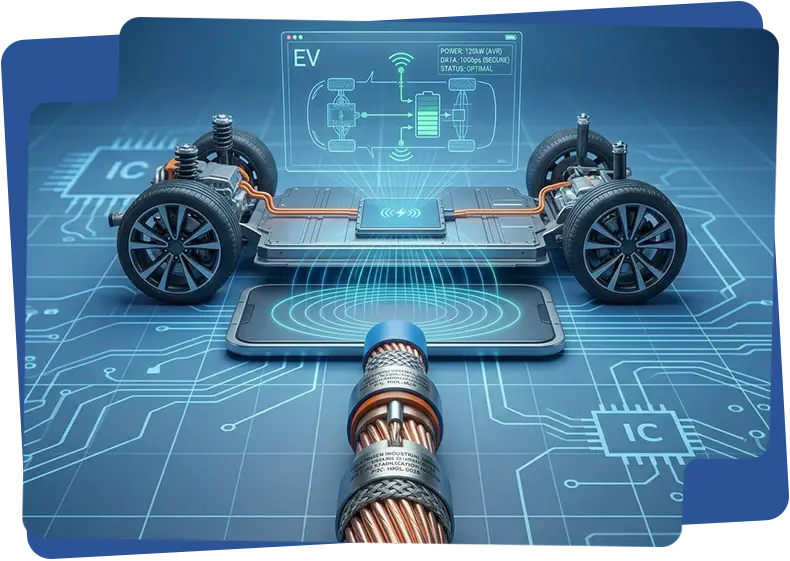
Will Wireless Power Replace High-Voltage Harness in Future EVs
The evolution of electric vehicle (EV) technology is raising an important question in the automotive and electronics manufacturing industry:
Will wireless power transmission eventually replace high-voltage wiring harness systems inside EVs?
With increasing focus on vehicle efficiency, design simplification, safety, and autonomous mobility, wireless power is gaining attention. However, the reality is more nuanced.
Let’s explore the current situation, technological progress, and future possibilities.
Role of High Voltage Wiring Harness in EVs Today
High voltage wiring harnesses remain the backbone of EV electrical architecture.
They are responsible for transmitting power between:
- Battery pack
- Inverter
- Motor
- On-board charger
- Power distribution systems
Why they are critical:
- High efficiency (minimal energy loss)
- Proven reliability
- Safety compliance
- Cost-effective large-scale manufacturing
- Suitable for high-power transmission (hundreds of kW)
Today’s EV platforms (400V and 800V architectures) are fully dependent on wired power distribution.
What is Wireless Power in EV Context?
Wireless power transfer (WPT) uses electromagnetic induction or resonant coupling to transfer energy without physical cables.
Current applications:
- Wireless charging pads for EV parking
- Dynamic wireless charging (charging while driving, pilot stage)
- Low-power internal electronics supply (experimental)
This technology aims to improve user convenience and reduce physical connectors.
Major Challenges Preventing Replacement of HV Harness
Power Transfer Efficiency
Wireless systems still face energy loss challenges.
- Wired harness: ~95-98% efficiency
- Wireless charging: typically lower efficiency
- Heat generation and alignment sensitivity
For high-power EV systems, efficiency is critical for range and performance.
High Power Transmission Limitations
EV motors require very high current flow.
Wireless transfer at such power levels:
- Needs large coils
- Requires advanced cooling
- Increases system complexity
- Raises electromagnetic safety concerns
This makes full wireless internal power distribution impractical today.
Cost & Infrastructure Constraints
Wireless power technology requires:
- New vehicle platform design
- Ground infrastructure installation
- Advanced shielding systems
- Higher component costs
For mass-market EV adoption, wiring harness remains more economical and scalable.
Safety & Regulatory Approval
Wireless high-power transmission introduces concerns like:
- Electromagnetic exposure
- Interference with vehicle sensors
- Certification challenges
- Reliability in harsh environments
Global automotive safety standards still favour wired power distribution.
Where Wireless Power WILL Impact EVs
Instead of replacing harnesses, wireless power is likely to complement existing systems.
Future use cases:
- Autonomous vehicle charging (no human intervention)
- Fleet charging infrastructure
- Smart cities & dynamic charging highways
- Reduction of external charging connectors
- Low-voltage interior applications
This will reduce dependency on charging cables – not internal HV harness.
Future EV Electrical Architecture Trends
- Zonal electrical architecture reducing harness length
- Aluminium high voltage cables for lightweighting
- Smart harness with embedded sensors
- Modular battery systems
- Increased automation in harness assembly
These trends show that wiring harness technology itself is evolving, not disappearing.
Conclusion
Wireless power is an exciting innovation and will play a supporting role in EV charging ecosystems.
However, high voltage wiring harness systems will remain essential for:
✔ Safe high-power transmission
✔ Vehicle reliability
✔ Manufacturing scalability
✔ Regulatory compliance
In the foreseeable future, the EV industry will move towards a hybrid approach – wired internal power + wireless charging convenience.