
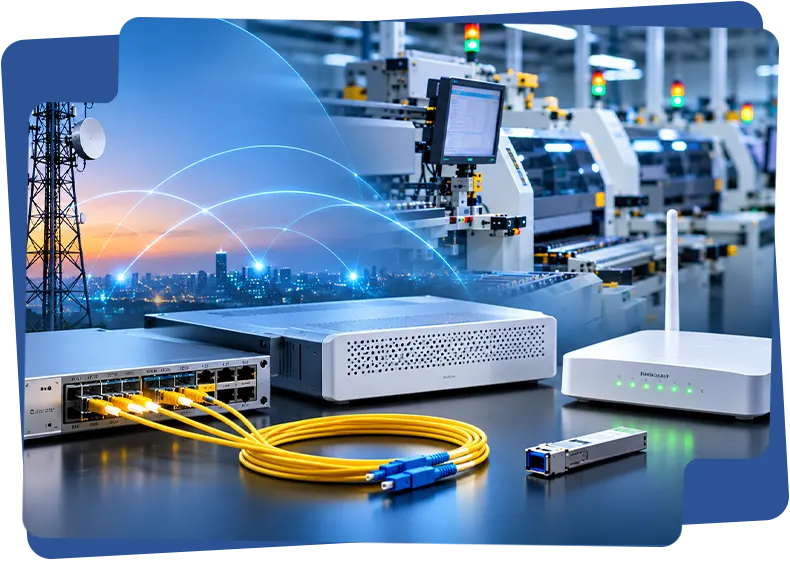
Powering Telecom Infrastructure: The Electronics Behind Broadband Connectivity
Introduction
Behind every seamless video call, high-speed internet connection and connected digital service is a sophisticated network of telecommunications infrastructure. While users experience connectivity through routers, broadband devices and network services, the technology enabling these experiences relies on complex electronic systems working together.
The rapid expansion of fibre-optic networks, broadband connectivity, data consumption and digital infrastructure is transforming the telecommunications industry. As connectivity requirements continue to evolve, telecom equipment manufacturers are under increasing pressure to deliver products that are reliable, efficient, scalable and capable of supporting growing network demands.
At the heart of this transformation lies electronics manufacturing.
From Printed Circuit Board Assemblies (PCBAs) and optical networking equipment to power systems, communication modules and integrated electronic devices, manufacturing precision plays a critical role in building the infrastructure that keeps the world connected.
Let’s explore the electronics behind modern broadband infrastructure and the manufacturing capabilities supporting its evolution.
1. The Growing Importance of Electronics in Broadband Infrastructure
Broadband connectivity has become an essential part of modern infrastructure. Businesses, households, industries and public services increasingly depend on uninterrupted internet access and high-speed data transmission.
Technologies such as Fibre-to-the-Home (FTTH), Gigabit Passive Optical Networks (GPON), Wi-Fi and next-generation communication networks are driving demand for increasingly sophisticated telecom equipment.
Some of the essential electronic products supporting this ecosystem include:
- Optical Network Terminals (ONTs).
- Optical Line Terminals (OLTs).
- GPON and XGS-PON equipment.
- Wi-Fi routers and broadband gateways.
- Fibre-optic communication modules.
- IPTV and Set-Top Boxes (STBs).
- Network switches and communication equipment.
Each of these products relies on multiple electronic components, interconnected circuit boards, communication interfaces and power management systems.
As broadband infrastructure expands, manufacturers must ensure that these electronic assemblies meet the performance, quality and reliability requirements of modern communication networks.
2. PCB Assembly: The Electronic Foundation of Telecom Equipment
Printed Circuit Board Assembly (PCBA) is one of the most critical manufacturing processes in telecommunications equipment.
A PCB provides the physical platform for mounting and connecting electronic components, enabling different parts of a device to communicate and function together.
Telecom products such as routers, ONTs, OLTs and network switches depend on sophisticated PCB assemblies incorporating:
- Microprocessors and controllers.
- Memory components.
- RF and Wi-Fi modules.
- Optical communication interfaces.
- Power management circuits.
- High-speed connectivity components.
Surface Mount Technology (SMT) plays an important role in manufacturing these assemblies, enabling precise component placement and efficient production.
As telecom equipment becomes more compact and technologically advanced, manufacturers must maintain strict process control, component placement accuracy and soldering quality.
Automated inspection, testing and quality assurance further support the production of reliable electronic assemblies.
3. Fibre Optics and the Electronics Behind High-Speed Connectivity
Fibre-optic technology has transformed the way data is transmitted across communication networks.
Unlike traditional copper-based transmission, fibre-optic networks use light signals to carry information over long distances with high bandwidth and low signal attenuation.
However, the infrastructure supporting fibre-optic communication requires more than optical cables.
It also depends on specialised electronic equipment that converts, processes, manages and distributes data across networks.
Key technologies include:
Optical Network Terminals (ONTs): Devices installed at customer premises that convert optical signals into electrical signals for connected devices and local networks.
Optical Line Terminals (OLTs): Equipment located at the service provider’s central office that manages communication between the broadband network and multiple ONTs.
Optical Transceivers: Components that convert electrical signals into optical signals and vice versa.
GPON and XGS-PON Equipment: Technologies that enable high-speed broadband connectivity through passive optical networks.
The manufacturing of these products requires the integration of PCBA, communication modules, power electronics, connectors and mechanical enclosures.
Reliable electronics manufacturing is therefore essential to supporting the performance and consistency of fibre-optic communication infrastructure.
4. The Role of Box Build Assembly in Telecom Equipment Manufacturing
Modern telecom products are not simply individual circuit boards. They are integrated electronic systems comprising multiple components and subsystems.
This is where Box Build Assembly becomes important.
Box Build involves integrating PCB assemblies, wiring harnesses, connectors, power systems, mechanical enclosures and other components into a complete functional product.
In telecommunications manufacturing, this process can support the assembly of:
- Broadband routers and gateways.
- Network communication equipment.
- Optical networking devices.
- Industrial communication systems.
- Power distribution and backup systems.
An integrated manufacturing approach helps streamline the transition from individual electronic assemblies to finished equipment.
It also enables better coordination between electrical integration, mechanical assembly, wiring, testing and final quality inspection.
For telecom OEMs, working with an EMS partner offering both PCBA and Box Build capabilities can simplify manufacturing operations and supplier coordination.
5. Quality and Reliability: Critical Requirements in Telecom Manufacturing
Telecommunications infrastructure operates continuously, supporting businesses, households and essential digital services.
Consequently, the reliability of electronic equipment is a major consideration for telecom manufacturers.
A manufacturing defect in a circuit board, connector, power supply or communication interface can affect the performance of an entire device.
Several manufacturing and quality processes help address these challenges:
Component Inspection: Verifying electronic components against specifications and ensuring material quality.
Automated Optical Inspection (AOI): Identifying potential PCB assembly defects through automated visual inspection.
Soldering Quality Control: Maintaining consistent solder joints and assembly quality.
Functional Testing: Verifying that assembled electronic products perform according to their intended specifications.
Final Assembly Inspection: Checking connectors, wiring, enclosures and other integrated components before product release.
A structured quality management approach helps manufacturers maintain consistency throughout the production process.
For telecom OEMs, manufacturing quality is not simply about meeting production specifications. It is about ensuring dependable equipment performance throughout the product lifecycle.
6. Why Integrated EMS Partnerships Matter for Telecom OEMs
As telecom products become increasingly sophisticated, manufacturers must coordinate several interconnected production activities.
Managing PCB assembly, cable manufacturing, mechanical integration, component sourcing and final assembly through multiple independent suppliers can create operational complexity.
An Electronics Manufacturing Services (EMS) partner can help simplify this process by bringing multiple manufacturing capabilities together.
An integrated EMS partnership can offer:
- PCB Assembly and SMT manufacturing.
- Cable and Wiring Harness Assembly.
- Box Build and Electromechanical Integration.
- Power Cord Manufacturing.
- New Product Introduction (NPI) support.
- Testing and Quality Assurance.
- Manufacturing and Export Support.
For telecom OEMs, this integrated approach can improve coordination between manufacturing processes, support production planning and provide greater flexibility as product requirements evolve.
Selecting the right EMS partner is therefore an important consideration when developing or expanding telecom equipment manufacturing operations.
7. The Future of Telecom Electronics Manufacturing
The telecommunications industry continues to evolve with increasing demand for faster connectivity, higher network capacity and improved infrastructure reliability.
Several developments are expected to influence the future of telecom electronics manufacturing.
Expansion of Fibre-Optic Networks
The continued expansion of FTTH and fibre-based broadband infrastructure will sustain demand for optical networking equipment, ONTs, OLTs and related electronic assemblies.
Growth of Wi-Fi Technology
The evolution of Wi-Fi standards and connected devices is driving demand for increasingly sophisticated networking equipment and RF modules.
Higher Electronic Integration
Telecom equipment manufacturers are working with increasingly compact and integrated electronic architectures, creating greater requirements for precision PCB assembly and system integration.
Manufacturing Automation
Automation, digital inspection and improved production monitoring are helping electronics manufacturers strengthen process consistency and manufacturing efficiency.
Supply Chain Localization
OEMs are increasingly evaluating manufacturing partners and regional supply chains that can support production flexibility, component sourcing and long-term operational requirements.
Together, these developments are creating new opportunities for electronics manufacturers supporting the global telecommunications ecosystem.
Conclusion
The future of broadband connectivity depends on more than fibre-optic cables and communication networks. It relies on the electronic systems, circuit boards, communication modules and integrated equipment that enable these networks to operate.
From PCB assembly and optical networking devices to complete Box Build solutions, electronics manufacturing plays a fundamental role in the development of modern telecommunications infrastructure.
As the demand for reliable and high-speed connectivity continues to grow, telecom OEMs will increasingly depend on manufacturing partners capable of delivering quality, precision and integrated manufacturing solutions.
Supporting the Future of Telecom Electronics Manufacturing
At inYantra Technologies (A Volex Company), we support the evolving electronics manufacturing ecosystem through integrated manufacturing capabilities designed to serve OEM requirements across multiple industries.
Our capabilities include:
- PCB Assembly (PCBA)
- Box Build and System Integration
- Cable and Wiring Harness Assembly
- BIS-approved Power Cords
- New Product Introduction (NPI)
- Testing and Manufacturing Support
With capabilities relevant to broadband, fibre-optic technologies, networking equipment and communication electronics, inYantra aims to support customers across different stages of the electronics manufacturing process.
As the telecommunications industry continues to advance, we remain committed to supporting OEMs with manufacturing solutions focused on quality, precision and operational consistency.
Looking for an EMS partner for your telecom or broadband equipment manufacturing requirements?
Connect with inYantra Technologies to explore our electronics manufacturing capabilities.