
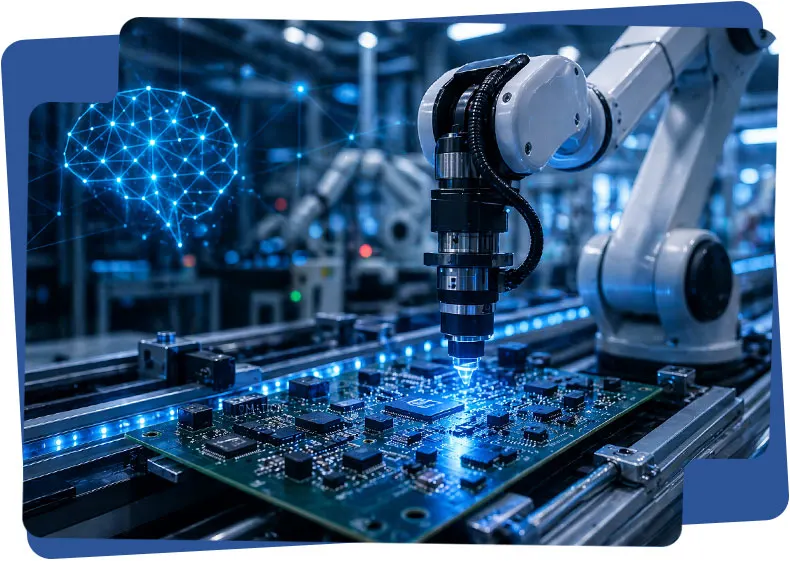
AI in Electronics Manufacturing: Hype vs Reality
“AI will revolutionise manufacturing.”
You’ve heard this everywhere. But if you’re an OEM or product company, the real question is:
Is AI actually delivering value in electronics manufacturing or is it just another buzzword?
Let’s separate hype from reality, so you can make informed decisions.
The Hype Around AI
AI is often marketed as a magic solution that will:
- Replace manual labour completely
- Eliminate defects entirely
- Run factories autonomously
- Instantly optimise production
Sounds impressive – but largely unrealistic (for now).
Most electronics manufacturing environments are:
- Complex
- Variable
- Dependent on human expertise
AI is not replacing manufacturing – it’s enhancing it.
Where AI is Actually Working (Real Use Cases)
1. Automated Optical Inspection (AOI)
AI-powered AOI systems can:
- Detect micro-defects in PCBs
- Reduce false positives
- Improve inspection accuracy over time
Reality: AI improves quality control – but still requires human validation.
2. Predictive Maintenance
AI analyses machine data to:
- Predict equipment failures
- Reduce downtime
- Improve maintenance planning
Reality: Useful for large-scale operations – but depends heavily on data quality.
3. Process Optimisation
AI helps:
- Optimise SMT line performance
- Improve yield rates
- Reduce material wastage
Reality: Incremental improvements – not overnight transformation.
4. Demand Forecasting & Planning
AI supports:
- Inventory planning
- Demand prediction
- Production scheduling
Reality: More accurate than traditional methods – but still affected by market uncertainty.
Where AI Falls Short (Today)
1. Full Automation
AI cannot run a complete electronics factory independently.
Human expertise is still critical for:
- Decision-making
- Problem-solving
- Process adjustments
2. High Implementation Cost
AI systems require investment in:
- Data infrastructure
- Integration
- Skilled resources
ROI is not immediate – especially for low-volume manufacturing.
3. Data Dependency
AI is only as good as the data it receives.
Poor data = poor results
Many manufacturers struggle with:
- Inconsistent data
- Lack of standardisation
4. Not Plug-and-Play
AI solutions require:
- Customisation
- Training
- Continuous monitoring
It’s not a “switch-on” solution.
Hype vs Reality (Quick Comparison)
| Claim | Reality |
|---|---|
| AI replaces humans | AI supports humans |
| Zero defects | Reduced defects |
| Fully autonomous factories | Semi-automated systems |
| Instant ROI | Gradual improvement |
| One-size-fits-all | Custom implementation |
What Smart OEMs Are Doing in 2026
Instead of chasing hype, leading companies are:
✔ Adopting AI selectively
✔ Focusing on high-impact areas (inspection, maintenance)
✔ Combining AI with human expertise
✔ Partnering with manufacturers who understand both tech and production
The goal is not automation – it’s efficiency + reliability.
What This Means for Your Manufacturing Strategy
If you’re evaluating manufacturing partners, don’t just ask:
“Do you use AI?”
Ask:
✔ “Where does AI improve quality and efficiency?”
✔ “How is it integrated into real production processes?”
✔ “What measurable results does it deliver?”
This separates real capability from marketing claims.
How inYantra Approaches AI in Manufacturing
At inYantra Technologies Pvt. Ltd., the focus is practical – not hype-driven.
AI and automation are used where they deliver real value:
- Enhanced inspection and quality control
- Process optimisation
- Reliable production outcomes
Combined with strong engineering and manufacturing expertise
Final Thought
AI is not the future of electronics manufacturing.
Smart use of AI is.
The winners won’t be those who adopt AI blindly – but those who use it strategically to improve quality, efficiency and scalability.